Global Partners Push to Accelerate Kigali Amendment Implementation to Limit Warming Ahead of COP31
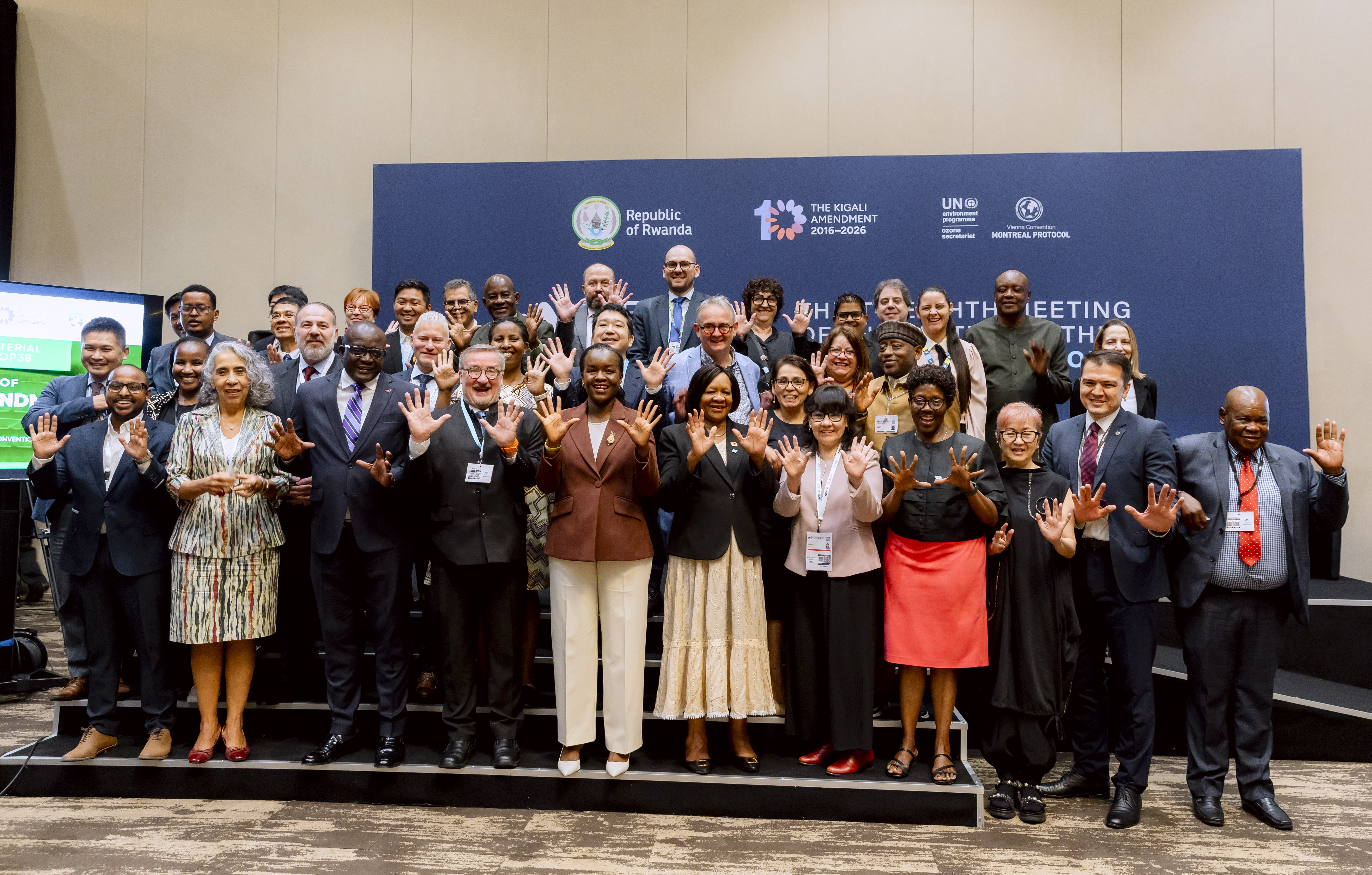
Ministers and international partners from industry, civil society and philanthropy gathered in Kigali today to renew their commitment to accelerating implementation of the Kigali Amendment, a landmark global agreement that could prevent up to 0.5°C of global warming by 2100 through the phasedown of hydrofluorocarbons (HFCs). Combined with improvements in cooling energy efficiency, the climate benefits could double to approximately 1°C.
Meeting on the sidelines of the 38th Meeting of the Parties to the Montreal Protocol (MOP38), the Friends of the Kigali Amendment discussed how to strengthen political cooperation, mobilise investment and accelerate the transition to affordable, energy-efficient and climate-friendly cooling.
Ten years after the Amendment was adopted in Kigali, Rwanda's Minister of Environment, Dr Bernadette Arakwiye, called for greater focus on implementation.
“The full climate and development benefits of the Amendment will only be realised through effective implementation. The next decade must therefore be a decade of delivery,” said Minister Arakwiye.
The Minister outlined four priorities for the Friends: achieving universal ratification, accelerating implementation, mobilising resources and partnerships, and strengthening industry leadership to drive innovation and investment.
Elizabeth Maruma Mrema, United Nations Assistant Secretary-General and Deputy Executive Director of UNEP, emphasised the Amendment's importance in limiting global temperature rise, particularly as the world faces the prospect of exceeding 1.5°C of warming.
“Full and effective implementation of the Kigali Amendment is the essential part of our response,” she said, highlighting the urgent need to reduce HFCs and other powerful super polluting greenhouse gases.
Meg Seki, Executive Secretary of the Ozone Secretariat, reaffirmed the scale of the opportunity, noting that the climate benefits of the Kigali Amendment could double when HFC reductions are combined with greater energy efficiency.
“This contribution is so significant and so necessary in this warming world,” she said.
The meeting also highlighted the importance of financing and partnerships. Tina Birmpili, Chief Officer of the Multilateral Fund Secretariat, noted that “no single project, no single funder” can transform a country's cooling sector. She highlighted support already provided to 141 countries to prepare for and begin implementing the Kigali Amendment.
Participants also emphasised the need to ensure that developing countries, particularly in Africa, can access efficient cooling technologies rather than becoming markets for obsolete, energy-intensive equipment and high-emitting refrigerants.
“Looking ahead, the future must be defined by inclusive progress,” said Minister Ali Faris Yoosuf, Minister of State of the Maldives’ Ministry of Climate Change, Environment and Energy. “We must strengthen international cooperation, expand access to affordable and energy-efficient cooling technologies, and continue investing in capacity building and sustainable refrigerant management. Importantly, our efforts to phase down HFCs must go hand in hand with improvements in cooling energy efficiency to maximize climate benefits while ensuring that cooling remains accessible to those who need it most,” he added.
Countries also stressed the importance of an integrated and systemic approach in Kigali implementation for lasting impacts, as well as the need to to strengthen research and innovation in countries, with industry taking a role and collaborating with the academe and civil society to build technical capacity.
“As we celebrate 10 years of the Kigali Amendment, parties need to invest in Research and Development programmes in climate friendly technologies and also find a way to harness funding from multilateral institutions into a Revolving Fund to sustain programmes that enhance continued compliance,” according to Zimbabwe’s Minister of Environment, Climate and Wildlife Evelyn Nlovu.
Lifecycle refrigerant management (LRM) also emerged as a concrete opportunity for enhanced international cooperation, including through information and experience sharing and exploring potential approaches under Article 6 of the Paris Agreement relating to HFCs. Civil society also called for stronger lifecycle management measures, including leak prevention, restrictions on disposable cylinders, and adequate funding for refrigerant recovery, reclamation and destruction.
Launched in September 2026, the renewed Friends of the Kigali Amendment initiative, led by Rwanda with support from the Climate and Clean Air Coalition, brings together governments and partners to accelerate implementation while reinforcing the existing institutions of the Montreal Protocol.
“To go above and beyond, we need political will, trust and collaboration. The CCAC brings together the ecosystem on cooling and super pollutants. This was critical in securing the Kigali Amendment and it is as critical in delivering it,” said Martina Otto, Head of the Coalition Secretariat.
As a Founding Friend and co-convener of the launch of the group, the United Kingdom recognised the different circumstances that countries face and highlighted the need to work together on practical solutions that can deliver lasting change.
“The Friends initiative can help bring together governments, international partners, industry, and technical expertise behind our shared task and goals, complementing and reinforcing the work of the Montreal Protocol. In the Kigali Communiqué, we reaffirmed the central role of the Multilateral Fund while recognizing the contribution that wider finance, technical cooperation, and practical partnerships can make,” said Billy Stewart, Development Director of the British High Commission in Kigali.
With 176 of the 198 Parties to the Montreal Protocol having ratified the Kigali Amendment, the Friends will continue working to expand participation, strengthen partnerships and turn commitments into measurable climate action.
Notes to Editors
About the Kigali Amendment
Adopted in Kigali in 2016, the Kigali Amendment to the Montreal Protocol established a global phasedown of HFCs. As of August 2026, 174 of the 198 Parties to the Montreal Protocol had ratified the Amendment.
About the Friends of the Kigali Amendment
The Friends of the Kigali Amendment is a voluntary, high-level and action-oriented coalition of governments working to secure the full climate and development benefits of the Kigali Amendment. Led by Rwanda, it is intended to reinforce, rather than duplicate, the institutions and processes of the Montreal Protocol.
About the Climate and Clean Air Coalition (CCAC)
The Climate and Clean Air Coalition (CCAC) is a voluntary partnership of governments, intergovernmental organizations, businesses, scientific institutions and civil society organizations committed to improving air quality and protecting the climate through actions to reduce short-lived climate pollutants. Its global network includes hundreds of state and non-state partners, and hundreds of local actors carrying out activities across economic sectors. CCAC is also the Secretariat to the Global Methane Pledge. The CCAC Secretariat and Trust Fund are hosted by UNEP.
For more information, please contact:
- Basile Uwimana, Communications and Outreach Specialist, Ministry of Environment: buwimana@environment.gov.rw.
- Vincent Hughes, Communications and Media Consultant, Climate and Clean Air Coalition Secretariat at United Nations Environment Programme: Vincent.Hughes@un.org.
- Ava Bahrami, Communications Officer, Climate and Clean Air Coalition Secretariat at United Nations Environment Programme: Ava.Bahrami@un.org.